

Expert Tips for Peak Performance and Longevity
Owning a new or used pool table is more than just adding a game to your home—it’s investing in a piece of recreational history that traces back to 15th-century European croquet variants, evolving into the precision-engineered billiard tables we enjoy today. With the surge in home game rooms post-2020 (driven by hybrid work trends and a renewed focus on indoor entertainment), proper maintenance has never been more crucial. Neglect can lead to issues like uneven ball rolls from a mere 0.01-inch slate imbalance or a 20-30% drop in ball speed due to felt wear. At Pro Billiards in Michigan, with over 20 years of servicing tables across harsh winters and humid summers, we’ve seen it all—from warped frames in unheated basements to restored antiques playing like new.
This guide goes beyond basic tips, drawing on physics (e.g., cushion rebound efficiency at 85-90% for optimal shots) and real-world case studies to help you maintain your table for decades. Whether you’re a casual player or tournament enthusiast, you’ll find DIY steps, pro recommendations, and preventive strategies to ensure consistent performance. We’ll cover components, schedules, detailed how-tos, common pitfalls, and more—making this the most comprehensive resource available. For complex tasks like re-leveling or re-felting, consider our Michigan-based pool table services for guaranteed results. Also check our related posts on when to re-felt your table and pool table moving costs.
Understanding Your Pool Table’s Components
Before diving into maintenance, you should know what makes your table tick. A standard billiard table isn’t just wood and fabric—it’s a system designed for precision physics, where even minor wear affects gameplay. For more on choosing the right play surface, see our guide to slate vs. other materials.
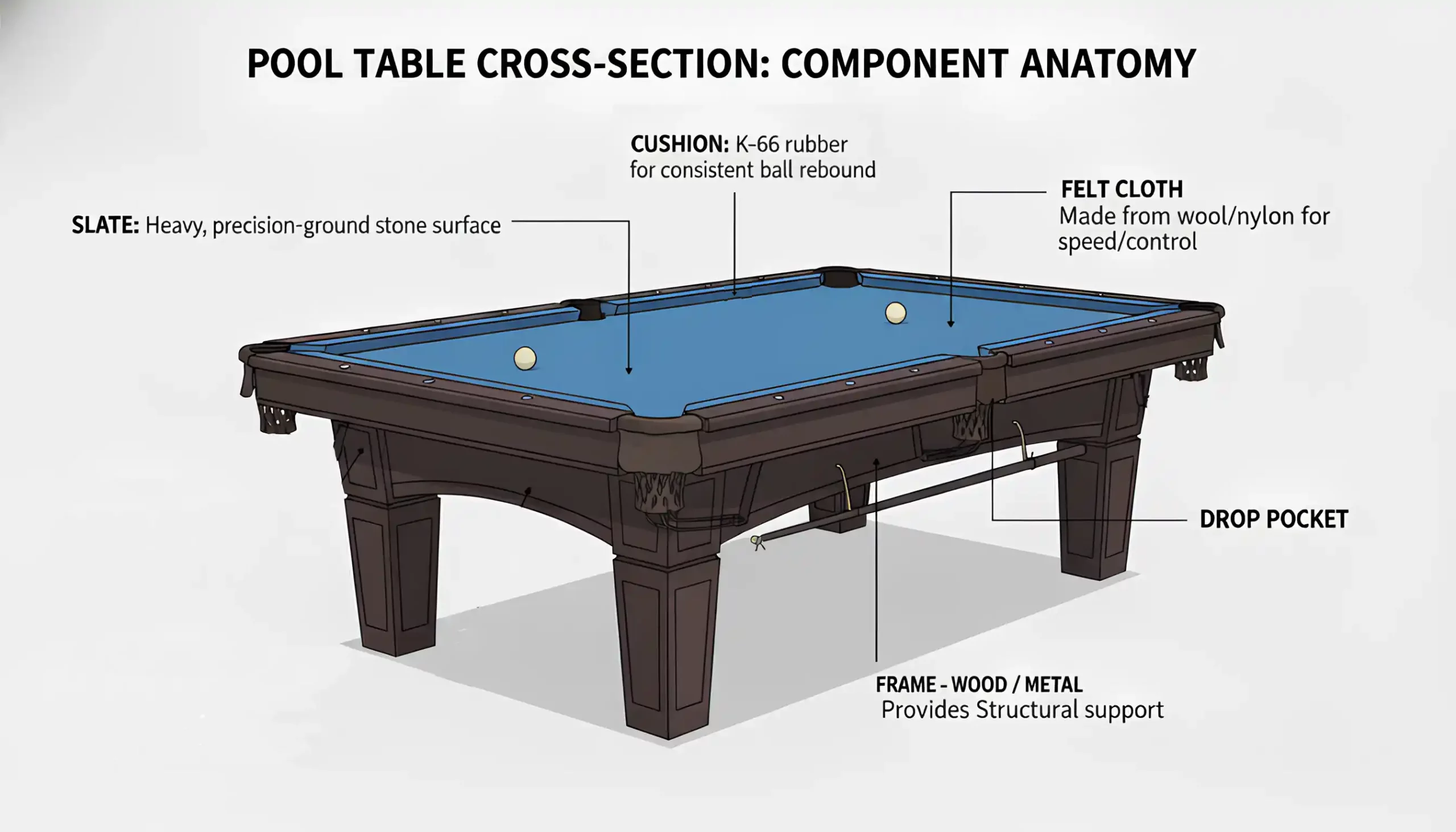
- Slate Bed: The foundation, is typically 3/4 to 1-inch thick natural slate (density 2.5-3 g/cm³ for stability). It provides a flat surface for true ball rolls and can last 75-100+ years with care. Cracks from improper moving are common culprits for uneven play—If you are moving a pool table and want to avoid any mishaps, check out our pool table moving service.
- Felt/Cloth: Wool-nylon blend stretched to 10-12 lbs/inch tension for smooth, friction-controlled rolls (coefficient around 0.2-0.3 for worsted cloths). American-style (worsted for speed) vs. British (napped for spin) affects maintenance—worsted is more durable but shows chalk faster. For premium options, visit our pool table felting service page.
- Rails/Cushions: Vulcanized rubber (K-66 or K-55 profiles) engineered for 85-90% momentum rebound, ensuring predictable bounces. Loss of elasticity over time reduces this to 70%, making shots inconsistent.
- Pockets: Leather or synthetic; drop-pocket (balls collect below) vs. return (balls roll back). They endure constant impacts, so conditioning prevents cracking.
- Frame/Legs: Solid wood (oak, maple) or metal; susceptible to warping in humidity fluctuations (ideal 40-50% RH).
- Accessories: Balls (phenolic resin for durability), cues (maple shafts), and chalk— all interact with the table. Explore our tips for buying used high-end cues.
Compare billiard table components in this table for a quick reference:
| Component | Material | Key Physics/Function | Common Wear Signs | Replacement Interval |
|---|---|---|---|---|
| Slate Bed | Natural slate | Flatness (tolerance 0.005 inches/foot) for accurate rolls | Cracks, chips from impact/moving | 75-100+ years |
| Felt | Wool/nylon | Low friction (0.2-0.3 coefficient) for speed/control | Fading, tears, chalk buildup | 3-7 years (heavy use) |
| Cushions | Rubber | 85-90% rebound efficiency | Softening, dead spots | 10-20 years |
| Pockets | Leather/synthetic | Ball capture without rebound loss | Cracking, loosening | 5-15 years |
| Frame | Wood/metal | Structural support | Warping, scratches | Lifetime with care |
Essential Pool Table Maintenance Schedule
Consistency is key—unlike sporadic cleaning, a structured routine prevents 80% of common issues. Tailored for variable climates (freezing winters, humid summers), here’s a customizable calendar:
- Daily/After Each Session (5-10 minutes): Brush felt, wipe rails, cover table. Clean balls to remove chalk residue.
- Weekly (15-20 minutes): Vacuum felt (low suction), inspect cushions for rebound, polish wood.
- Monthly (30 minutes): Check level with a machinist’s tool, condition pockets, monitor humidity (use app-connected hygrometer).
- Quarterly (1 hour): Deep clean all surfaces, test ball roll for inconsistencies, tighten bolts/frame.
- Annually (Pro Service Recommended): Full inspection, re-leveling, potential re-felting. Cost: $200-500, but extends life by 5-10 years. Book our pool table storage if seasonal.
- Seasonal Adjustments: Winter—humidify to 40-50% RH to prevent wood cracking; Summer—dehumidify to avoid mold on felt.
Building on Maintenance Basics
These expanded steps incorporate science, tools, and pro insights for superior results.
Cleaning the Felt
Chalk dust reduces friction by 15-20%, slowing play. Brush in straight lines from head to foot end—never circles, as it mats fibers. Vacuum weekly with upholstery attachment on low (avoid high suction to prevent stretching). For stains: Mix 1:1 vinegar-water, dab gently (test patch first). Eco-tip: Use biodegradable cleaners for sustainable care. For more on felt wear, read our re-felting signs post.
Protecting the Felt
Use a pool table cover when the table is not in use to block UV fading (which degrades color by 50% in 2 years) and spills. Ban heavy objects as indentations can disrupt slate flatness.
Myth busted: Vacuuming doesn’t always tear felt if done right, but brushing first lifts debris better.
Maintaining the Cushions
Test rebound monthly: Drop a ball from 6 inches—it should bounce 3-5 rails consistently. Clean with damp microfiber (no abrasives). If under 80% efficiency, give us or your local professional a call, we have revived thousands of pool tables over the years!
Ensuring a Level Playing Field
Use a precision level (0.005-inch accuracy). Adjust legs/shims quarterly. DIY limit: Minor tweaks, let the pros handle slate seams. Unevenness can cause balls to drift 1-2 inches over 8 feet and can be frustrating for precision games. Contact us or your local pro for professional leveling.
Caring for the Slate
Inspect for cracks (use flashlight). If moving, disassemble professionally—slate weighs 800+ lbs and shifts easily. Re-level post-move to maintain tolerance. If you’re curious about the costs associated with moving a pool table check out our moving cost breakdown article.
Polishing the Rails and Pockets
Use citrus-based wood polish (e.g., Howard Feed-N-Wax) quarterly for rails. Condition leather pockets with beeswax to prevent drying (apply thin layer). Repair or replace worn pockets promptly to avoid ball jams.
Rotating and Cleaning the Balls
Wash with mild soap or a cleaner like Aramith Cleaner weekly with heavy use and bi-monthly with normal use, this removes dirt that can scorch felt. Inspect for chips and if you have 2 sets of balls, rotate them for even wear.
Pro tip: Use low-residue chalk like Taom V10 to minimize buildup. If you need new billiard balls give us a call, we have a huge selection of new and used pool balls!
Controlling the Environment
Ideal temperature and humidity is 65-75°F / 40-50%. Use dehumidifiers in basements that are naturally damp to prevent warping—excess moisture can swell wooden frames by 5-10%.
Professional Maintenance
Annual or semi annual professional service can catch any issues early before they become problems. We offer inspections including rebound tests and tension checks. Call us for a free quote!
Pro vs. DIY Comparison:
| Task | DIY Time | Pro Time | Benefits of Pro |
|---|---|---|---|
| Re-Felting | 8 hours | 2 hours | Perfect tension, no wrinkles |
| Leveling | 1 hour | 30 min | Precision tools, warranty |
| Cushion Replace | 4 hours | 1 hour | Matched rebound, expertise |
Common Mistakes, Myths, and Troubleshooting
Avoid these pitfalls for hassle-free ownership:
- Mistakes: Sitting on rails (warps frame), aggressive shots (tears felt), drinks nearby (stains permanent). atlanticspasandbilliards.com +1 Over-vacuuming stretches cloth.
- Myths Debunked: “Ironing felt fixes wrinkles”—only for napped types, and risky (can melt nylon). “Any chalk works”—cheap ones build up faster, slowing play.
- Troubleshooting: Uneven rolls? Re-level slate. Dead cushions? Test rebound/replace. Faded felt? UV exposure—add cover. Stains? Act fast with vinegar; pros for deep clean.
Case study: A Michigan family’s table suffered winter warping—we fixed it with humidity control and re-leveling, saving $1,000 on replacement.For broader industry standards, refer to the Billiard Congress of America.
FAQs
Every 3-7 years, depending on use (heavy: 3 years; light: 7+). Signs: Tears, slow rolls.
Yes, low suction after brushing—avoids damage.
Low-residue like Taom V10 or Predator True.
Use dehumidifiers; check RH weekly
Absolutely—prevents costly fixes; we offer free quotes.
Yes—supervise; use covers to block claws/hair :).
Mild soap, soft cloth—no abrasives.
Stable temp/humidity, no direct sun, space for cues. You can check out the room size needed for a pool table using our pool table room size calculator.
Ball bounce test: Less than 3 rails means yes.
Brush, vacuum attachment, level, polish, cover
This answer really depends on what is needed. You can call and ask us anytime, questions are free!
We highly recommend hiring a professional service to move a pool table. There are so many small and large things that can go wrong (we’ve seen them all) that we highly suggest the peace of mind that comes with an experienced crew of pool movers.
Chalk buildup or loose felt—clean and tension check.
Conclusion
Mastering pool table maintenance ensures every shot is precise and every game enjoyable, turning your table into a lasting heirloom. By following this guide—with its science-backed tips, schedules, and troubleshooting—you’ll outperform basic advice from elsewhere. Ready to elevate your setup? Schedule a free inspection or quote for leveling, re-felting, or storage in Michigan.
Contact us at 248.821.6112 or click for a quote. Share your tips in the comments below—let’s build a community of well-maintained tables!